

Nuclear Powerplants in India
#GS-03 Science and Technology
For Prelims
India and Nuclear Energy:
- Nuclear power is the fifth-largest source of electricity in India after coal, gas, hydroelectricity and wind power.
- Currently, India has 22 nuclear power reactors operating in 7 states, with an installed capacity of 6780 MegaWatt electric (MWe).
- 18 reactors are Pressurised Heavy Water Reactors (PHWRs) and 4 are Light Water Reactors (LWRs).
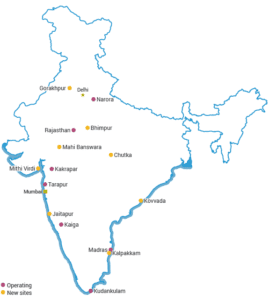
Operational Nuclear Power Plants in India |
|||
| Name Of Nuclear Power Station | Location | Operator | Capacity |
| Kakrapar Atomic Power Station – 1993 | Gujarat | NPCIL | 440 |
| (Kalpakkam) Madras Atomic Power Station – 1984 | Tamil Nadu | NPCIL | 440 |
| Narora Atomic Power Station- 1991 | Uttar Pradesh | NPCIL | 440 |
| Kaiga Nuclear Power Plant -2000 | Karnataka | NPCIL | 880 |
| Rajasthan Atomic Power Station – 1973 | Rajasthan | NPCIL | 1,180 |
| Tarapur Atomic Power Station – 1969 | Maharashtra | NPCIL | 1,400 |
| Kudankulam Nuclear Power Plant – 2013 | Tamil Nadu | NPCIL | 2,000 |
Nuclear Power Corporation of India Limited:
- The Nuclear Power Corporation of India Limited is an Indian public sector undertaking based in Mumbai, Maharashtra.
- It is wholly owned by the Government of India and is responsible for the generation of electricity from nuclear power.
- NPCIL is administered by the Department of Atomic Energy.
Rosatom:
- Rosatom, also known as Rosatom State Nuclear Energy Corporation is a Russian state corporation headquartered in Moscow that specializes in nuclear energy.
- Rosatom’s nuclear fuel division, TVEL Fuel Company, is the current supplier of TVS – 2 M fuel for the two VVER 1,000 MWe reactors generating power in the Kudankulam Nuclear Power Project (KKNPP).
- This fuel has an 18–month fuel cycle, meaning that the reactor has to be stopped for fresh fuel loading every one-and-a-half years.
- TVEL has now offered the more modern Advanced Technology Fuel (ATF), whose fuel cycle is 24 months.
- This will ensure more efficiency, additional power generation due to prolonged operation of the reactor and sizeable savings of the foreign exchange needed to buy fresh fuel assemblies from Russia.
Related Posts


